Methods of iterating
During the development of Draft 1, I focused primarily on my personal experiences and reflections within the relief printing process. In Draft 2, I integrated the perspectives on ‘process’ from the Conditional Design Manifesto, analyzing the origins of variables in relief printing through three specific dimensions: Time, Relationship, and Change. This framework provided me with a systematic methodology. Furthermore, the concepts of process in the manifesto helped me understand the iterative process in this brief and how to identify outcomes along the way.
Draft 1
While remaking Karel Martens’ work, I discovered that achieving a perfect facsimile is impossible. Even among the ten copies I produced, there were subtle differences. It prompts a critical inquiry: Replication could be a creative method when material and mechanical traces escape the maker’s control.
When I reconstruct the background text. I observed that most digital typewriter fonts are ‘pre-distressed’ with simulated ink bleeds and micro-displacements. Using digital tools to mimic these analog artifacts feels like a ‘reverse operation’ of design.
Through the practice of relief printing, I realized that 100% copy is unattainable due to a multitude of uncontrollable variables: the varying absorbency and texture of the substrate, the fluctuation in ink volume and drying rates, the duration of pressure, and the micro-displacements of the patterns under the press. The convergence of these minute factors ensures that every output is unique. If the medium is inherently resistant to identical reproduction, then every attempt to copy is, in essence, an act of iterative invention.
Next, I will use the same tools to systematically investigate how a graphic performs on different papers and how controlling individual variables can generate a coherent system of images.

Draft 2
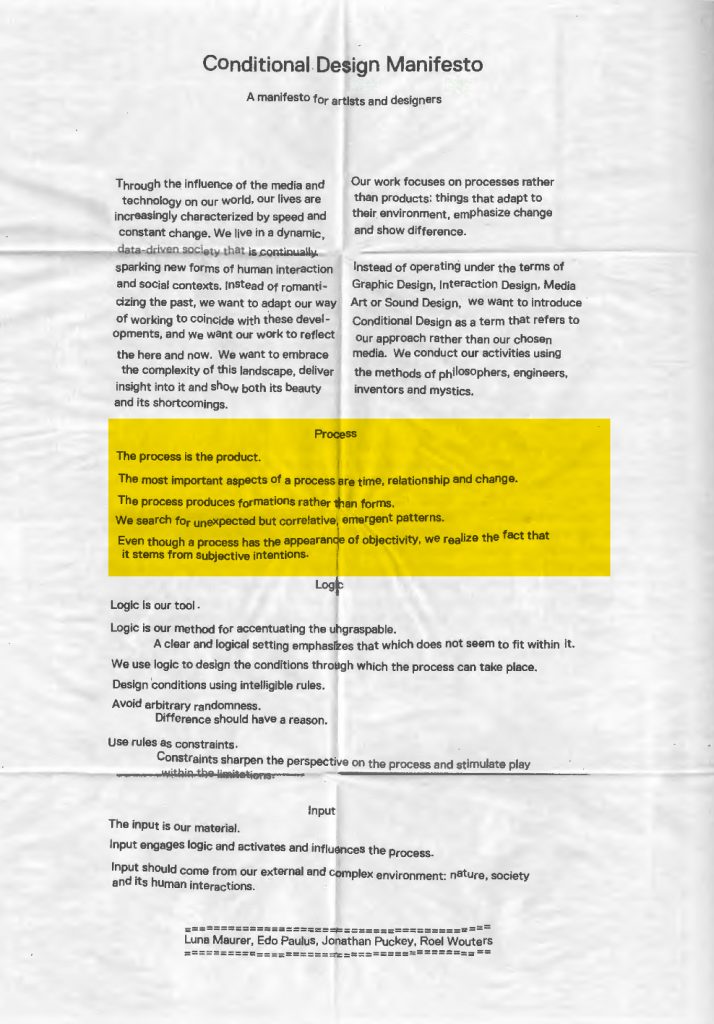
While remaking Karel Martens’ work, I realised that exact replication is practically impossible. Even among the ten copies I produced, there were subtle differences. Through the practice of relief printing, variations emerged as the result of numerous interdependent factors. To better analyze these factors, I followed Variables via Conditional Design Drawing from the Conditional Design Manifesto (2013), which posits that “the most important aspects of a process are time, relationship, and change.” I categorized the uncontrollable variables of relief printing below
- Time
The duration of pressure applied during printing directly affects the resulting image. Longer or shorter pressing times can alter ink transfer, density, and edge definition. In addition, the drying time of the ink and the printing sequence significantly influence how layers of ink interact with one another. Variations in drying speed determine whether inks overlap cleanly, smudge, or partially merge, producing different visual outcomes even when the same matrix is used. - Relationship
Relationship in relief printing is shaped by the interaction between matrix material, machinery, and paper. Cardboard and plastic retain ink differently. while manual and hydraulic presses apply pressure unevenly. Paper thickness, texture, and absorbency further affect ink transfer, edge sharpness, and drying time, producing unpredictable variations. - Change
Each printing iteration introduces subtle micro-displacements caused by variations in machine condition and manual force applied during operation. These differences result in minor misalignments or micro-displacements within the printed forms. Furthermore, the matrix changes over time through repeated use. For example, cardboard matrices gradually lose structural integrity, becoming uneven or dented, which in turn alters subsequent impressions. The matrix is therefore not a static tool. It is an evolving component within the printing process.
Karel Martens has stated that he sees himself more as an experimenter than a designer. The project allowed me to understand that position from my own experience. While printing with discarded plastic materials from CSM’s swap shop, I began to recognise the narrative power of waste. During the printing process, I observed that the printed marks repeatedly escaped the boundaries of my intended composition, appearing on protective newspapers, surrounding surfaces, and unintended areas beyond the printing paper. In some cases, these uncontrolled traces were even sharper and visually more compelling than the forms I had deliberately designed.
To interrogate the boundary of control in relief printing, I designed a dragon scale binding book. Within the inner pages’ structure of this book, I contrasted my printed graphics with those that appeared by chance to explore when accidental patterns continuously emerge out of paper, on waste materials, and worktable, are they residue, or can they be redefined as components of the work? If the final visual outcome is a product of material and mechanical autonomy, does authorship shift from the designer to the machine and tool? Ultimately, this project allowed me to experience how an experimental graphic designer creates work through iteration. And I learnt how to find the final product within an open-ended, process-driven trajectory.
Draft 3
First Edition colour
Second Edition blind debossing
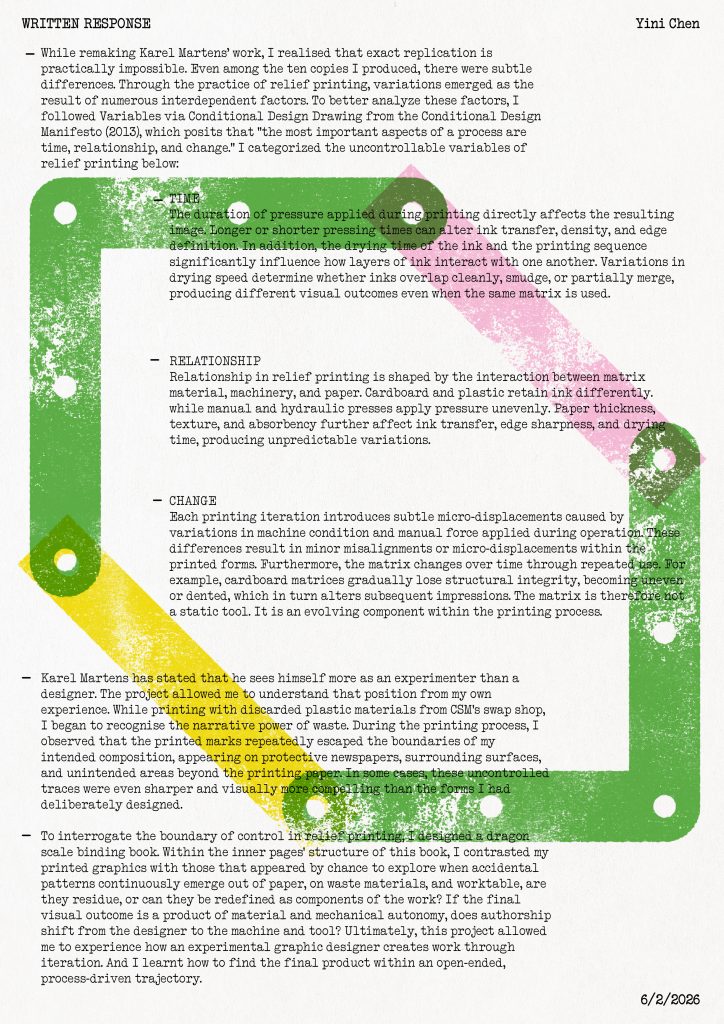
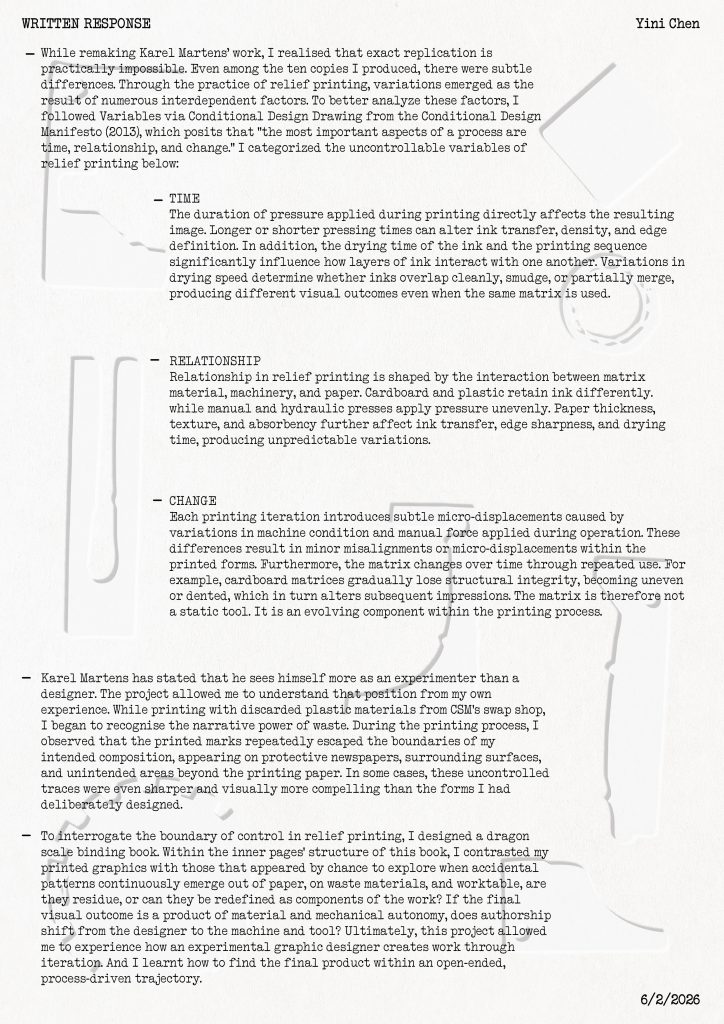
In visualizing my written response, I adopted a similar visual language to Karel Martens’work. I used the same font in the original work I remade to capture the feeling of a document on a desk. However, a comparative analysis reveals a distinct divergence in the primary focus of our work. While Martens prioritizes graphic pattern and relegates text to an information-rich backdrop. By contrast, my work positions the text as the primary focus, with graphics serving a supporting role. This contract shows how a designer’s connection with content unconsciously steers the final visual outcome.

Maurer, L., Paulus, E., Puckey, J. and Wouters, R. (2013) ‘Conditional Design Manifesto’, in Conditional design workbook. Amsterdam: Valiz, pp. ii-xiv.