Methods of cataloguing
The What Women Want To Know collection includes advertising pamphlets that show the cultural and consumer expectations of women during the late nineteenth and early twentieth centuries. Most advertisements targeted white, middle- and upper-class women. The gender and racial representations in these materials reflect the social stereotypes and prejudices of that time.
I used metadata to study how systems of knowledge and visual design shaped ideas of femininity between 1888 and 1940. Then I used sequencing and captioning to visualize the historical archive. Following Foucault’s idea that every “order of things” comes from a specific historical system of classification (Foucault, 1989), the collection is not seen as separate advertising pamphlets, but as a structured system of social control, where morality, technology, and design together defined what a woman should be.
The metadata categories are arranged in time order to show how printing technology, social ideas, and artistic movements changed together over the years.
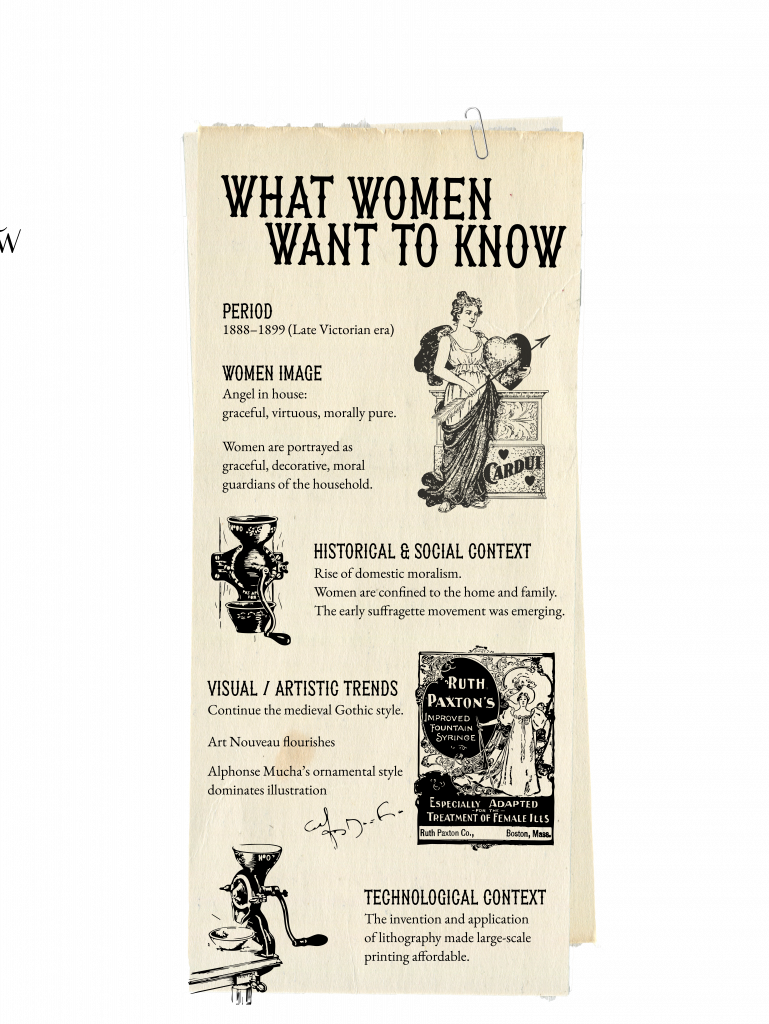
1888–1899 (Late Victorian Era)
This period was strongly influenced by domestic moral values. Lithographic printing made it possible to produce illustrated magazines for a wide audience. Under the influence of Art Nouveau, women were often shown as elegant and moral figures, sometimes described as “angels of the house.”
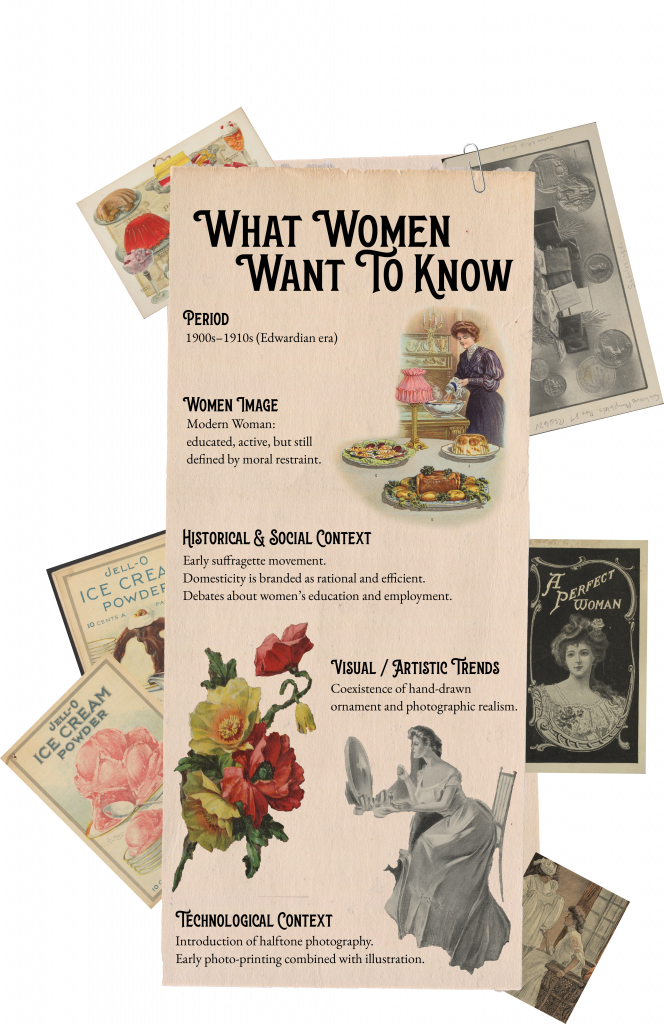
1900s–1910s (Edwardian era)
In the early twentieth century, the women’s suffrage movement began to grow. Halftone photography was introduced, combining realism with decorative illustration. The booklets during this period reflected women’s responsibilities in serving the family, and women’s skills (such as cooking, cleaning, and taking care of husbands and children) were mainly reflected in domestic roles.
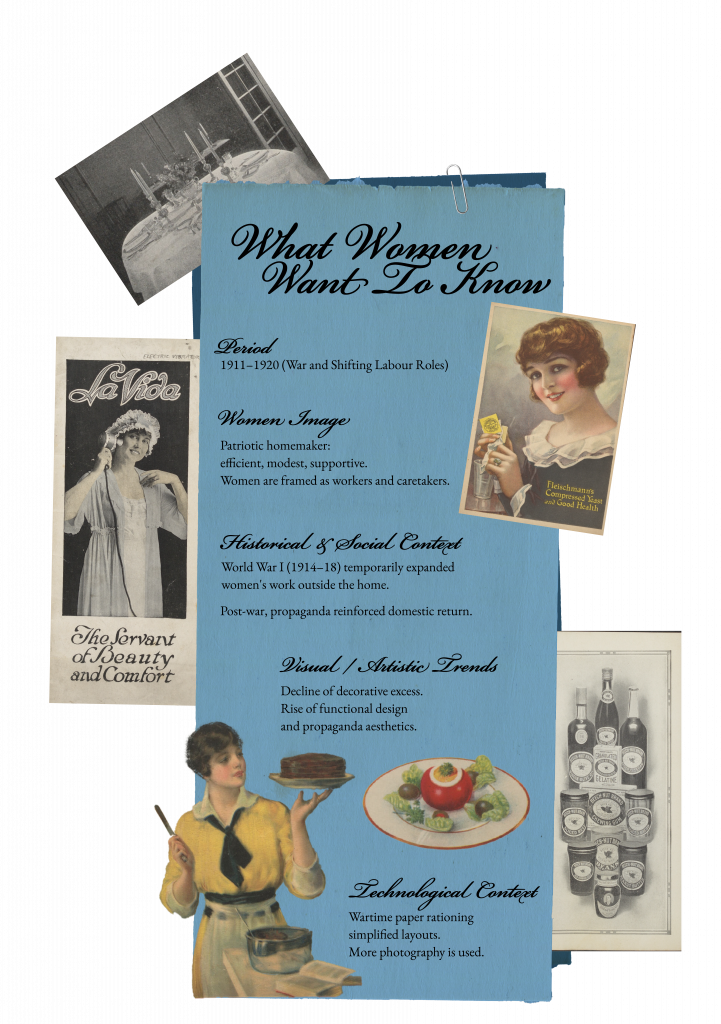
1911–1920 (World War I)
During the war, women became more visible in the workforce. Women in this period had the dual responsibilities of working and caring for their families. However, after 1918, many were encouraged to return to traditional domestic roles. Wartime publications used simple layouts and serious tones, linking a woman’s moral duty with her duty to the nation and family.
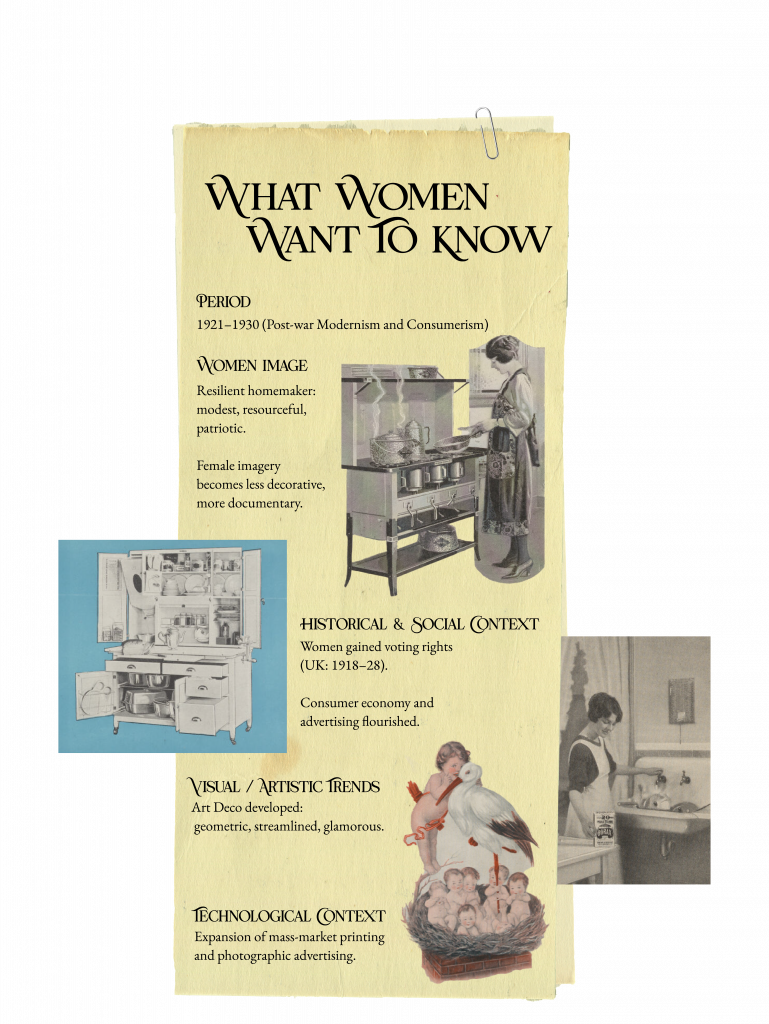
1921–1930 (Post-war Modernism)
After the war, women gained voting rights, and consumer culture expanded. At the same time, the government began to encourage childbirth, and with the development of medical technology, many booklets were published on childcare.The advertising industry adopted the clean, geometric look of Art Deco. Women were portrayed as practical, strong, and moral homemakers who supported family and nation during difficult times.
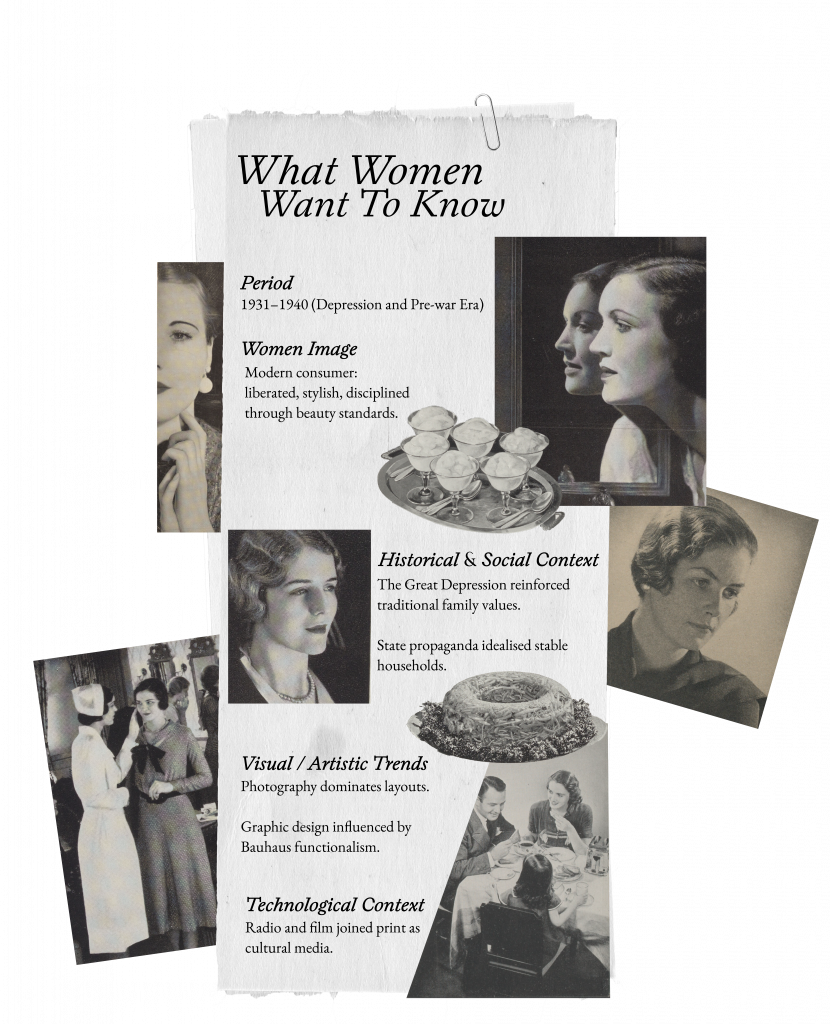
1931–1940 (Depression and Pre-war Years)
In the 1930s, social conservatism returned due to the economic depression. Photography became the main visual form, and design was influenced by the Bauhaus movement. The advertising industry adopted the clean, geometric look of Art Deco, presenting modern women as stylish and independent, but also responsible for managing their own beauty and appearance. Some of the requirements for women’s appearance (such as being slim, having exquisite makeup, and clothing) are still in effect today.
Just as each line on a palm suggests a different destiny, each decade’s visual language shows a new form of control over women. The move from illustration to photography did not mean freedom, but a more way of shaping how women were seen. While gathering this information, I was surprised to realise how the struggles of women have continued to repeat throughout history. Although the topic of feminism has been widely discussed on the internet, the situation has not improved much.

Foucault, M. (1989) The Order of Things: An Archaeology of the Human Sciences. London: Routledge.
Riley, P.J. and Kiger, G. (1999) ‘Moral discourse on domestic labor: gender, power, and identity in families’, The Social Science Journal, 36(3), pp. 541–548.
Wang, S. (2017) World History of Graphic Design. Beijing: China Youth Press.