Methods of contextualising
Statement
Focusing on the Student Hometown Travel dataset of NZSIP, our group’s exploration evolved into a critical interrogation of the graphic designer’s positionality. Although these emissions are generated by student movement, students should not be the targets of environmental blame since the mobility is embedded within the structures of a globalised education system.
The final work of our group is the Authorised Movement Pack. It is an archival publication that reframes student hometown travel as a procedural output of institutional systems. Through various official documents and sediment imagery, it reveals how emissions are produced, recorded, and assigned to individuals within structures of authorised mobility. Meanwhile, we adopted the visual language of geology to translate travel emissions into sedimentary formations to show how human mobility leaves permanent damage on the environment.
Throughout the design process, I repeatedly questioned whether we might unintentionally reinforce a narrative of individual responsibility. Do we have the authority to guide or regulate people’s lifestyles through visual language? Does visual communication risk reiterating and upholding institutional logics? Within the UAL Net Zero strategy practice, I gradually realise that the role of the graphic designer is not only to visualize data but also to reveal the responsibility distributed under a system.
Bibliography
1. On Unpublishing: Fugitive Materiality and the Future of the Anthropocene Book by Gilbert, Annette, 1975-, Bajohr, Hannes, (2016)
Anthropocene
This book mentions the concept of the ‘Anthropocene’. It is a theoretical support for our project. Anthropocene shows us the macro view of human activity and the ecosystem, and it is also the background of this project. At the same time, the images of Anthropocene also inspired the use of geological sedimentation to visualize aviation emissions.
Publishing is a part of Earth
In addition, Gilbert and Bajohr (2016) suggest that printed materials are not only tools for sharing information, it are also physical objects that exist within geological time in the future. Publications will eventually become part of the Earth. This idea changed how we understand publishing, and we began to rethink publishing as a medium that records environmental impact, not only as a method of communication. Inspired by this concept, we chose to show our position by a formal document, and these emissions are ultimately recorded within the environment. In this way, our Authorised Movement Pack not only records how UAL student movement leaves long-term traces on the planet, but also inquiry the duty of student home travel emissions.
2. Paper knowledge: Toward a media history of documents by Lisa Gitelman
This book discusses small documents and explains how they function as tools of authority. Gitelman (2014) argues that the power of paper items like tickets, receipts, and official forms suggests that documents not only record reality but also shape it. Gitelman’s research helps us understand that the official appearance of paper not only carries information of authority but also influences people’s understanding of responsibility (Gitelman, 2014). This concept is crucial to our Authorised Movement Pack. We began to consider what documents might exist during student home travel and what role they play. We presented our concept by redesigning the various official documents encountered while traveling by plane. By using this official document style, we aim to reveal that the carbon emissions from student home travel originate from the global education system. Simultaneously, it allows viewers to engage with the global education system through our Authorised Movement Pack.
3. Graphesis: visual forms of knowledge production by Drucker, Johanna
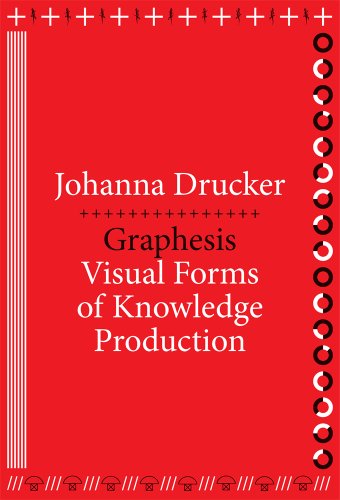
This book inspired us in the field of data visualisation. Drucker provides a descriptive and critical language for analysing graphical knowledge. The examples of data visualisation in the book made us think about how to make carbon emission data more accessible to the public. At the same time, Drucker argues that visual representation should not only “display” information, but also “interpret” it. Inspired by this idea, we combined student home travel data with images of geological sediment. This visual connection shows how carbon emissions enter the ecosystem and become a permanent and irreversible part into environment.
Drucker (2014) argues that visual systems can reflect power structures. She argues that visual forms such as charts and statistics are not neutral truths. They are constructed by observers, institutions, and media systems. This helped us rethink how to design the visual system of our Authorised Mobility Pack and how to combine it with geological imagery. As a result, we merged sediment visuals with a barcode form. The geological visual is not only decorative, but also part of the student mobility system. By scanning the sediment-style barcode, the process of aviation emissions entering the ecosystem becomes more concrete and visible.
4. Uncorporate Identity: Metahaven by Kruk, Vinca; and van der Velden, Daniel
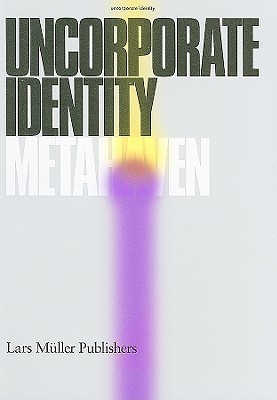
In this book, Metahaven and Vishmidt (2010) explore how visual language can challenge political and institutional systems. They argue that graphic design can be critical and political. The book introduces the idea of “design as a critical intermediary.” Designers should not only transmit information, but also reveal social and political structures. This idea provides theoretical support for our Authorised Movement Pack.
Furthermore, the book also discusses “the fiction of officialness.” It shows how designers imitate bureaucratic visual language, such as strict grids, complex lines, and cold typography, in order to expose how powerful institutions operate. And this sense of authority can be carefully designed and constructed (Metahaven and Vishmidt, 2010). In our Pack, the passport, ticket, luggage tag, and receipt all use this bureaucratic aesthetic. As Metahaven suggests, the more “official” a document appears, the stronger its sense of obligation becomes. By designing this official-looking Pack, we aim to reveal that student mobility is not purely personal freedom, but part of the globalised education system.
5. Heat by David Loy
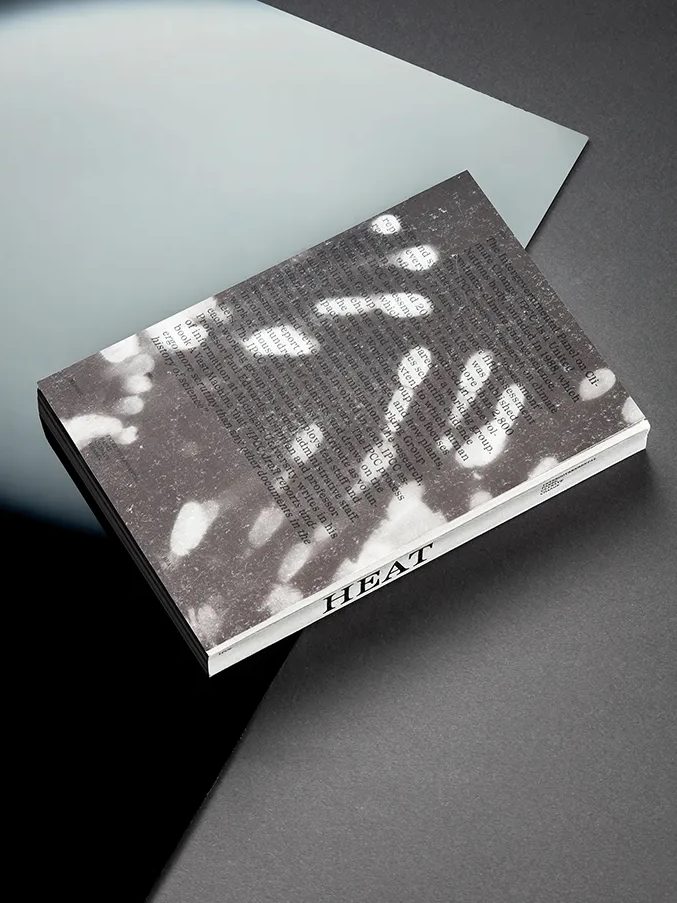
The cover of Heat uses thermochromic ink. When the reader touches the surface, the heat. The cover of Heat uses thermochromic ink. When the reader touches the surface, the heat from their hand leaves a visible handprint (Loy, 2019). This interactive element made us think about how to create a structure that helps readers understand complex content more easily and makes it accessible to more people. Each action by the reader leaves a temporary and slightly destructive visual mark on the book. This symbolises the impact of human activity on the planet.
Inspired by this sense of physical interaction and guilt, we designed a tear-off luggage tag. Just as touching the heat changes the cover, tearing the luggage tag is meant to “reduce weight.” However, the remaining text, “Footprint remains intact,” tells the viewer that this action is meaningless. The concept behind the tearable luggage tag is similar to Loy’s approach. It uses materiality to show the relationship between the micro individual and the macro environmental system, and to reveal its complexity and limits.
6. Forensic Architecture
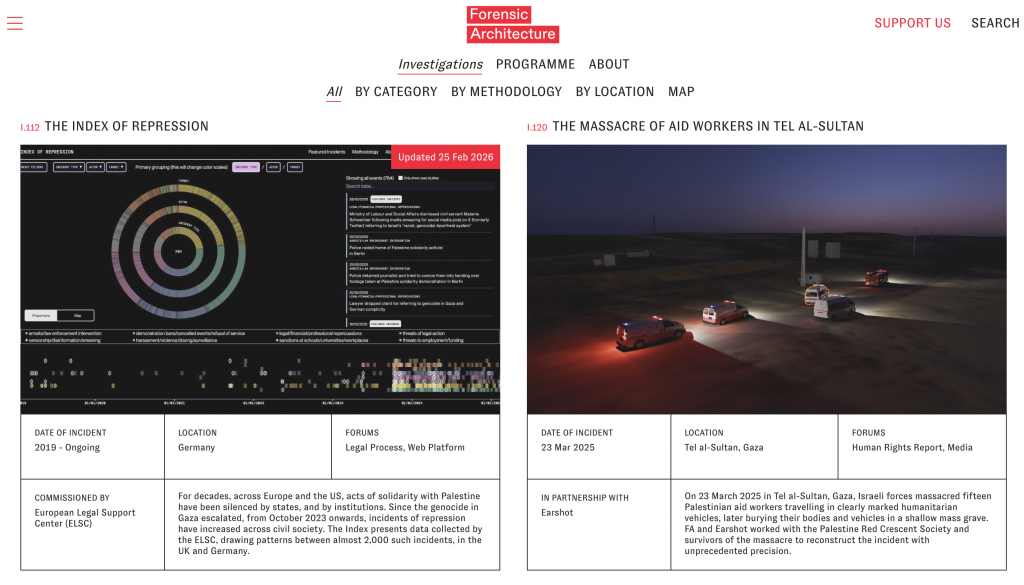
Forensic Architecture is a research institution that uses visual tools to investigate political and environmental issues. They combine maps, spatial models, videos, and data to reconstruct events. Their research demonstrates that visual evidence can reveal hidden power structures. They do not employ traditional graphic design but rather use design as a method of investigation (Forensic Architecture, no date). We were particularly impressed by their approach to transforming complex systems into clear visual narratives. Therefore, in our project, we adopted this approach, making carbon emissions and travel data part of a material archive, integrating the carbon emissions generated by individual travel behaviors into a systematic process.
Forensic Architecture (no date) explains that the method of “counter-forensics” provides an important perspective for our project. Inspired by their forensic aesthetics, we transform tickets and receipts from ordinary administrative documents into forms of evidence that reveal institutional responsibility. Just as Forensic Architecture (no date) explains that it uses material traces to reconstruct hidden violence, our project uses a geological visual language to make invisible carbon emissions visible as sedimentary records.

Reference:
Drucker, J. (2014) Graphesis: Visual forms of knowledge production. Cambridge, MA: Harvard University Press.
Forensic Architecture (no date) Forensic Architecture. Available at: https://forensic-architecture.org/ (Accessed: 2 March 2026).
Gilbert, A. and Bajohr, H. (2016) ‘On unpublishing: Fugitive materiality and the future of the Anthropocene book’, in Gilbert, A. and Bajohr, H. (eds.) Publishing as artistic practice. Berlin: Sternberg Press, pp. 282–294.
Gitelman, L. (2014) Paper knowledge: Toward a media history of documents. Durham, NC: Duke University Press.
Loy, D. (2019) Heat. [Place of publication not specified]: [Publisher not specified].
Metahaven and Vishmidt, M. (eds.) (2010) Uncorporate identity. Baden: Lars Müller Publishers.